MoRTH Revises PUC Certificate Validity Under CMVR Rule 115(7): 3-Year Validity for New BS-VI Private Vehicles
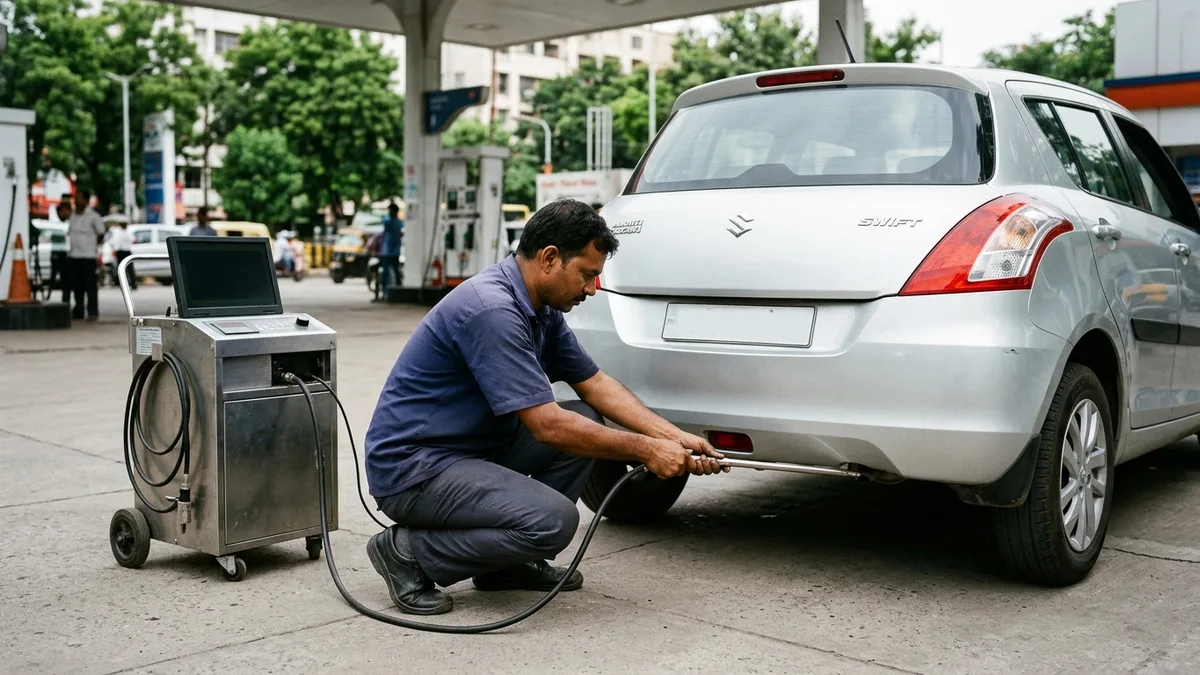
The Ministry of Road Transport and Highways (MoRTH) has amended sub-rule (7) of Rule 115 of the Central Motor Vehicles Rules (CMVR), 1989 under the Central Motor Vehicles (Sixteenth Amendment) Rules, 2026, restructuring how often Indian motorists must renew Pollution Under Control Certificates (PUCC). Notified on November 19, 2026, the revised framework ties emission testing frequency directly to Bharat Stage (BS) compliance, vehicle age, and private versus commercial classification.
Under the earlier nationwide schedule, BS-IV and BS-VI passenger cars were largely grouped into a flat 12-month renewal cycle after their initial one-year new-vehicle exemption, even though modern BS-VI powertrains equipped with On-Board Diagnostics (OBD-II) and catalytic converters maintain stable tailpipe emissions during early ownership. MoRTH stated that aligning testing intervals with real-world age degradation reduces routine queue friction for newer BS-VI owners while tightening oversight on older high-emission fleets.
Revised PUC Certificate Validity Schedule (CMVR Rule 115(7))
The updated national validity structure separates non-transport (white-plate private) and transport (yellow-plate commercial) BS-VI vehicles into three age tiers while setting uniform intervals for older BS-I through BS-IV models:
| Emission Standard & Vehicle Class | Vehicle Age from First Registration | Revised PUC Validity Period |
|---|---|---|
| BS-VI Non-Transport (Private Vehicles) | Up to 6 years | 3 years |
| BS-VI Non-Transport (Private Vehicles) | More than 6 years up to 10 years | 1 year |
| BS-VI Non-Transport (Private Vehicles) | More than 10 years | 6 months |
| BS-VI Transport (Commercial Vehicles) | Up to 6 years | 2 years |
| BS-VI Transport (Commercial Vehicles) | More than 6 years up to 10 years | 1 year |
| BS-VI Transport (Commercial Vehicles) | More than 10 years | 6 months |
| BS-IV Vehicles (Private & Commercial) | All ages | 6 months |
| BS-I, BS-II, and BS-III Vehicles | All ages | 3 months |
Impact on Private Car Owners and Commercial Fleet Operators
For individual buyers of BS-VI two-wheelers and four-wheelers, the 3-year validity window up to the sixth year of registration eliminates annual emission booth visits during the primary ownership cycle. Commercial fleet operators running BS-VI taxis, buses, and goods carriers receive a 2-year PUCC validity window for vehicles up to 6 years old, reducing fleet downtime between annual fitness inspections.
Conversely, owners of BS-IV vehicles face a shorter 6-month testing cycle nationwide instead of the previous 12-month interval that applied in several states. Older BS-I, BS-II, and BS-III vehicles remain on a strict 3-month testing cycle to catch exhaust deterioration early.
How to Verify Your Emission Norm and Updated Expiry on Parivahan
- Check Your Registration Certificate (RC): Confirm whether your vehicle is registered under BS-III, BS-IV, or BS-VI norms on the physical RC or in the mParivahan / DigiLocker app.
- Verify Active PUCC on VAHAN: Visit
puc.parivahan.gov.in, enter your registration number and the last five digits of the chassis number, and confirm the certificate matches an authorised testing centre ID. - Watch for Automated ANPR Enforcement: Metro corridors including Delhi NCR use camera-linked VAHAN checks to issue instant emission fines. Check pending notices through our All-India E-Challan Verification Guide or locate your zonal RTO District Office if your vehicle's emission norm is misprinted on VAHAN.